

COP, BTU, inverter technology, on/off technology… everything may seem clear on paper — until you look at what actually happens over a full pool season in Quebec.
What You Really Expect From a Pool Heat Pump
80°F and above
Fast heating
Reliability
Controlled costs
You Are Not Buying a Technology.
You Are Buying a Comfortable Pool.
When you buy a pool heat pump in Quebec, you expect a real result:
Water at 80°F (27°C) or more, regardless of the weather.
Water ready when you want to swim, with a fast temperature rise.
Reliable operation, with no missed swim days.
Controlled operating costs.
Two heat pumps with similar specifications can deliver very different results in Quebec. Choosing a pool heat pump in Quebec should always be based on real operating conditions, not only on technical specifications.
This is often what pool owners discover after installation: the actual performance does not always match what they expected.
A heat pump that cannot maintain the water temperature is not doing its job.
A Pool Season in Quebec Is Never Based on One Single Condition
A pool in Quebec operates under highly variable conditions: cold spring weather in May, summer storms, and cool nights in September and October.
It is precisely during these transition periods, in spring and fall, that the real performance of a pool heat pump becomes critical for extending the swimming season.
Nirvana: Real Power at All Times, Outstanding Performance at Low Temperatures
Thanks to robust assembly quality, a high-performance heat exchanger, and an oversized evaporator, Nirvana pool heat pumps are designed to deliver very high BTU performance at low temperatures.
This capability, supported by AHRI-certified data, contributes to more stable performance in spring, fall, and during cool nights.
The results presented are based on a comparative approach using certified data and identical conditions for all units. As with any model, certain simplifications are applied uniformly to ensure a coherent reading of the results.
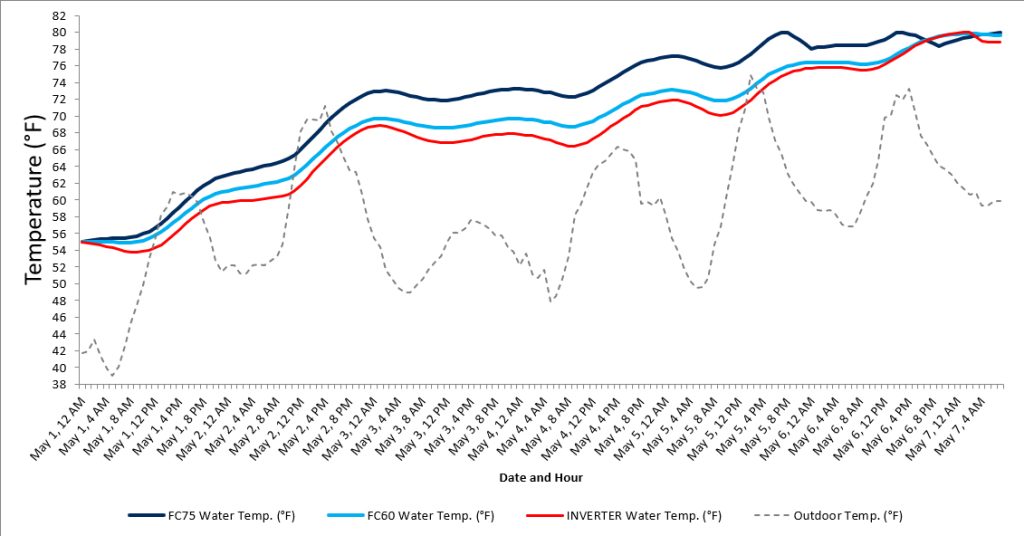
The Reality of Quebec When Trying to Reach 80°F Early in the Season
Reaching 80°F in Quebec is not only a question of efficiency — it is a question of real heating capacity. Even with comparable rated output, the differences become real.
This graph shows the concrete impact on the speed of temperature rise and the ability to maintain the target temperature.
Constantly Changing Conditions
In Quebec, conditions change constantly: temperature, humidity, and weather directly influence heat pump performance.
This graph illustrates how these variations affect the ability of each unit to maintain the pool water temperature under real operating conditions.
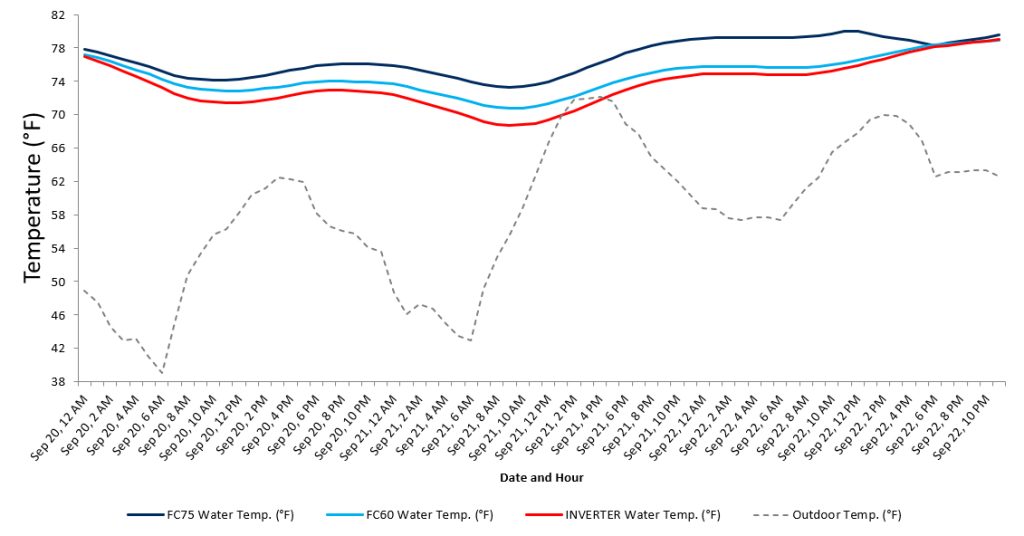
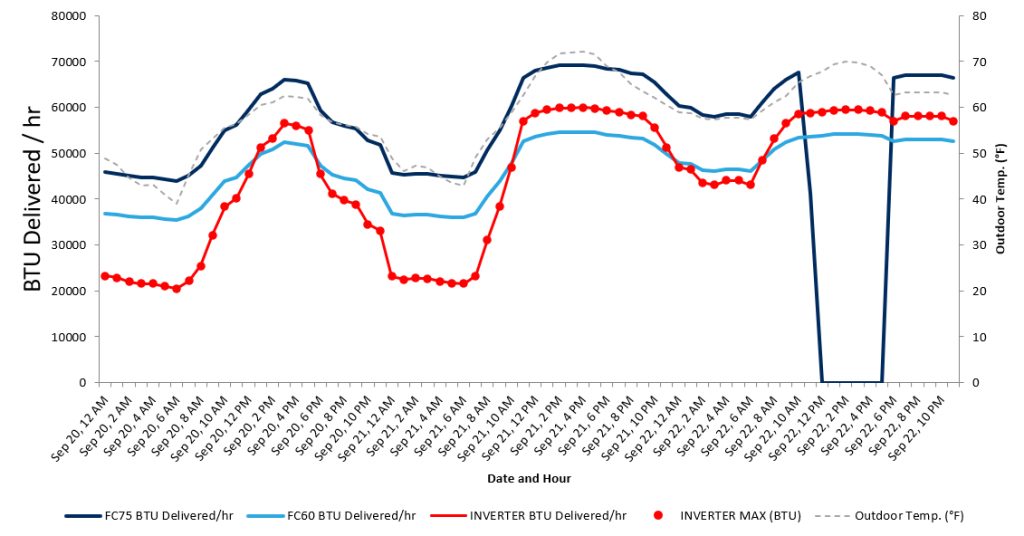
Limit Conditions: End of Season and Cool Nights
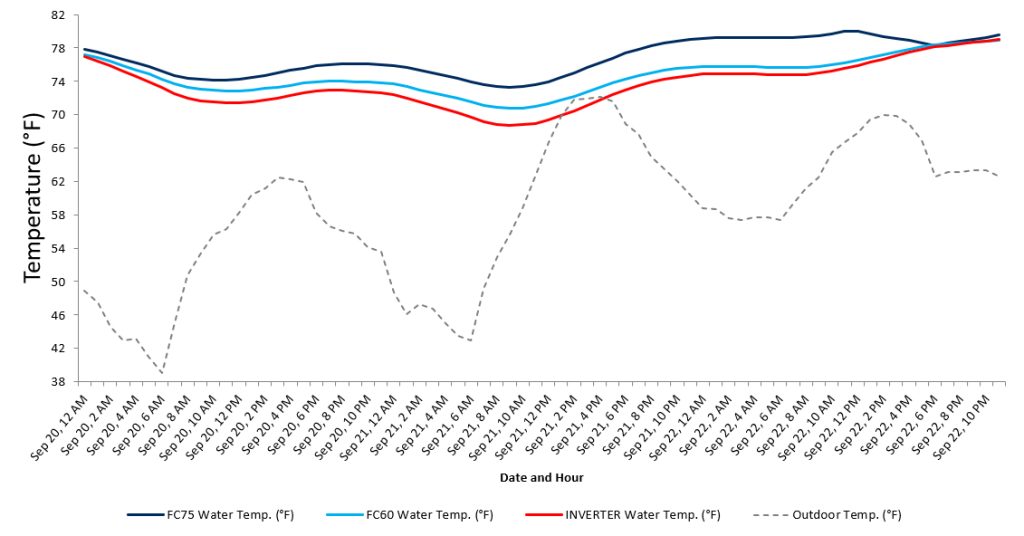
When nights are cool, performance is put to the test.
This graph shows the direct impact of these conditions on the ability of heat pumps to maintain the pool water temperature in September.
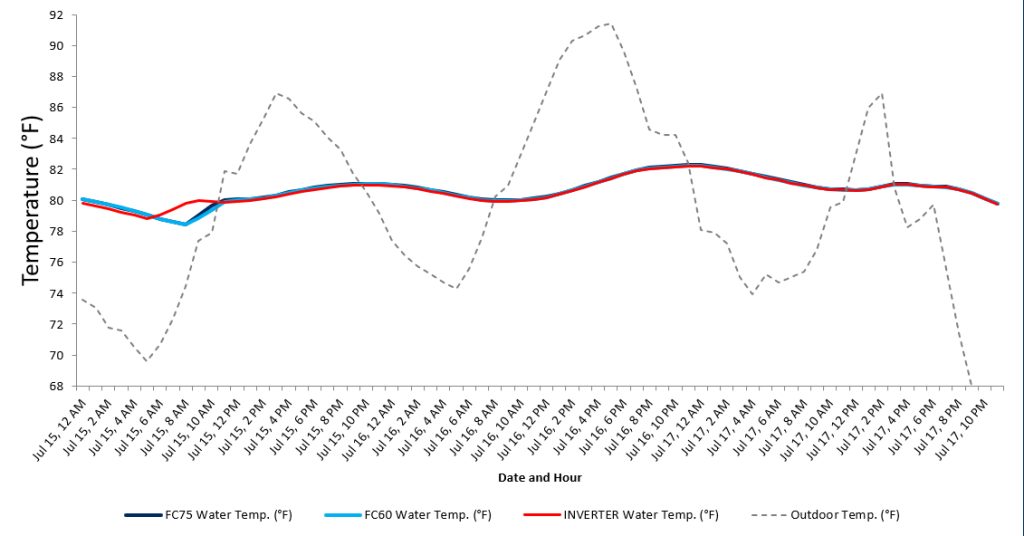
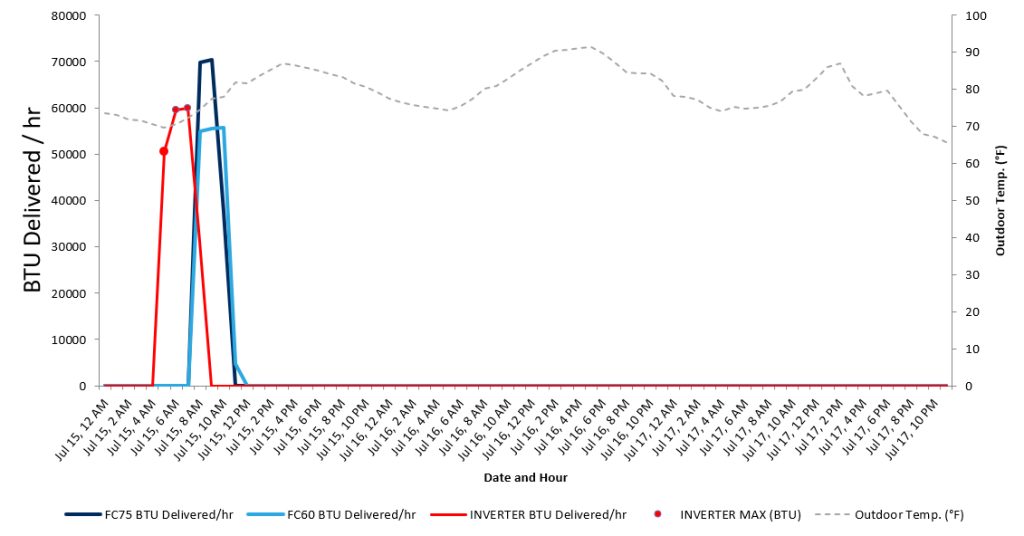
Summer Is Not the Problem
When the weather is warm, most pool heat pumps deliver similar results, as shown in July.
This is where real heat pump performance makes all the difference.
At Low Temperatures, Real Heating Capacity Makes the Difference
At low temperatures, real heating capacity becomes critical. Some heat pumps significantly reduce their output or stop operating, while others maintain a more stable heat production.
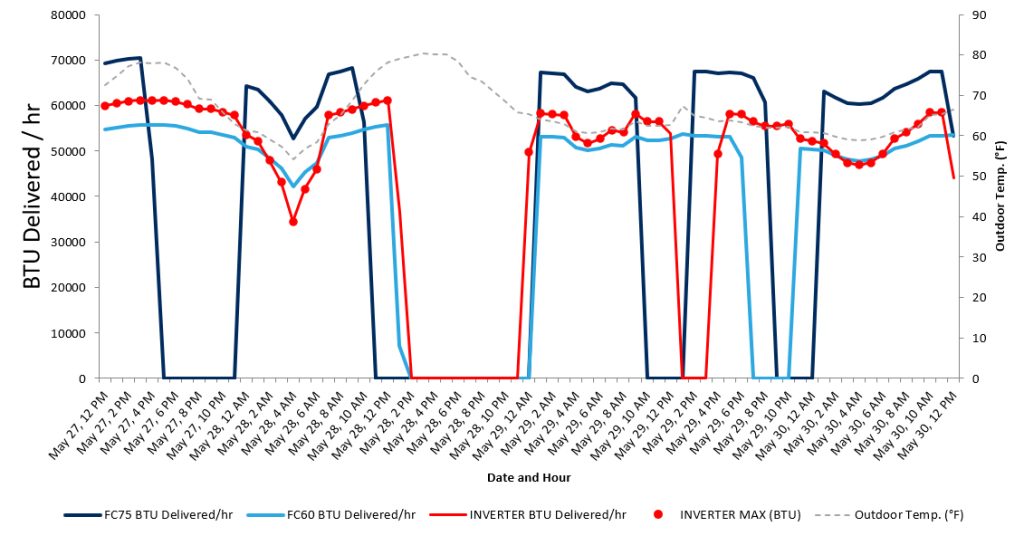
Capacity Drops as Temperature Falls
As the outdoor temperature decreases, some heat pumps quickly lose capacity.
Heat production then becomes less stable.
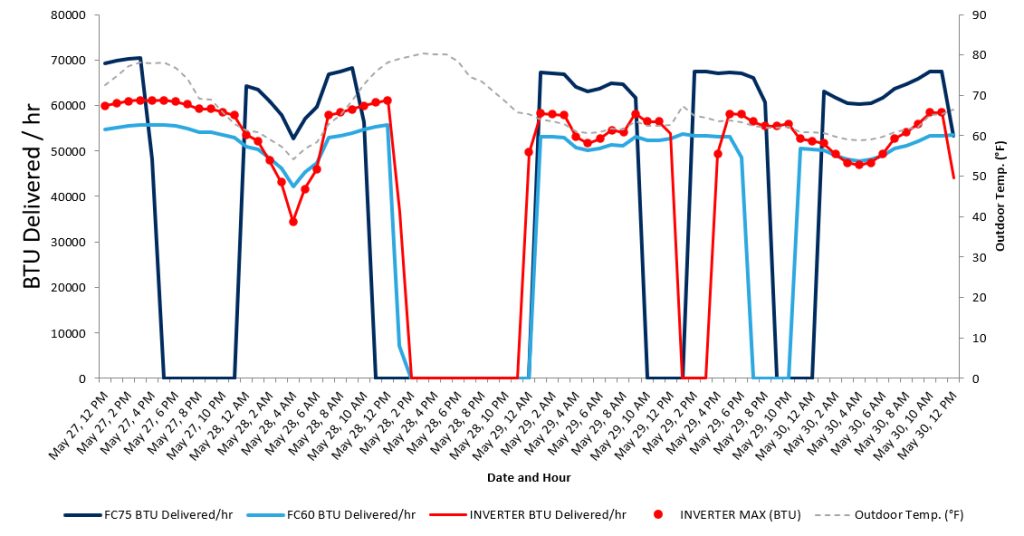
Capacity Maintained Despite Changing Conditions
Some heat pumps maintain a more stable heating capacity despite changing conditions.
This consistency allows them to produce heat more predictably, even under real operating conditions.
Similar Performance in Summer
At high temperatures, performance gaps are much less pronounced.
Most pool heat pumps then deliver similar results.
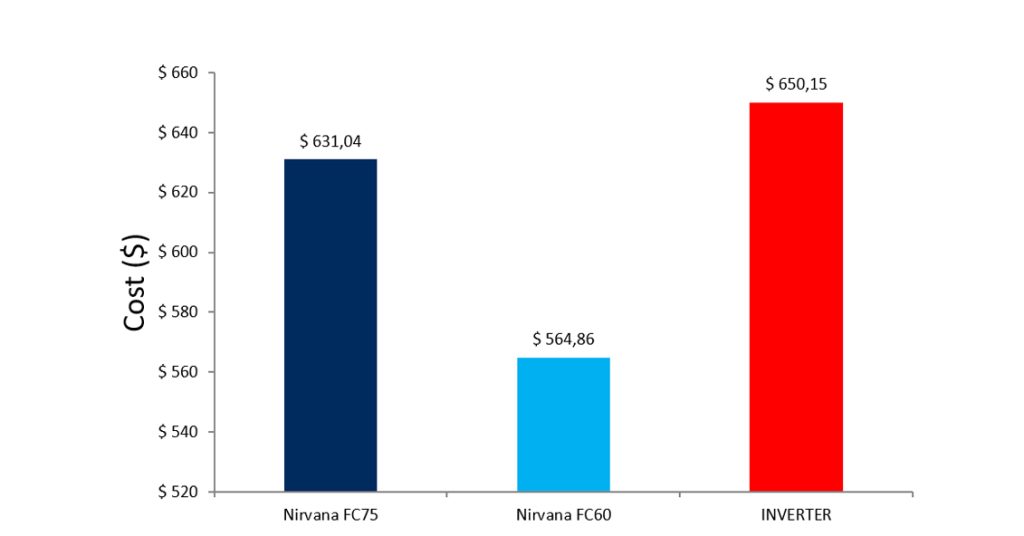
This difference in heating capacity has a direct impact on your costs.
The Real Impact on Your Costs — May to September Season
A less powerful heat pump has to run longer to reach and maintain the target water temperature.
This difference in operating time directly translates into higher electricity costs over the full season.
Methodology and Assumptions
These graphs come from a comparative thermal simulation based on real climate data from the 2025
With all variables kept constant — 45,000 L pool volume, installation conditions, no pool cover, and electricity cost — the comparison highlights each heat pump’s real ability to heat and maintain water temperature in the Quebec climate.
The assumptions used are conservative and applied uniformly to ensure a coherent comparison.
The observed differences reflect the overall behavior of the units over a complete season.
Heating needs are highest at the beginning of the season, which highlights the real capacity of each pool heat pump.
COP: An Essential Indicator, but One That Must Be Understood Properly
COP measures the ratio between the heat produced and the electricity consumed. The higher the COP, the lower the heating cost.
A high COP is often measured at 80°F air temperature, under ideal conditions that are rarely representative of Quebec’s climate.
In Quebec, what matters is the average COP over a full season, because it directly influences the real cost of pool heating.
Learn more about AHRI certifications and the price comparison tool.
High COP = lower heating cost
BUT COP varies depending on real operating conditions
In Quebec, what matters is the average COP over the entire season
What Heats Your Pool: Real Capacity at 50°F (10°C)
In Quebec, the problem is not simply heating the pool…
It is heating fast enough and maintaining the temperature.
BTU represents real heating capacity — in other words, how quickly your heat pump can recover from a temperature drop.
When someone recommends a 55,000 BTU heat pump, you expect it to do the job. In reality, AHRI-certified capacity at 50°F is the most important factor for your comfort under Quebec conditions.
This is often where the difference appears between a heat pump that performs effectively in Quebec and one that disappoints under real operating conditions.
Based on AHRI-certified data, some inverter models can show a significant drop in heating capacity between nominal conditions (80/80/80) and cooler conditions (50/63/80). These variations are consistent with the trends shown in the comparative data above.
In documented cases, this drop can reach very high levels — up to approximately 80%. For example, a model rated at 60,000 BTU can deliver around 11,500 BTU under these conditions.
Concrete Consequences
- Slower heating
- Unstable temperature
- The need to pay more to oversize the unit
RESULT
a pool that is harder to heat, less stable, and less enjoyable to use.
Why Inverter Technology Is Not Always Suited to Quebec
Some heat pumps rely on marketing.
Others are built around real-world performance.
Inverter pool heat pumps now occupy an important place in the market, with promises of efficiency and modulation. But in the Quebec climate, these promises do not always translate into real performance.
Inverter technology is widely used in residential heating and air conditioning, where needs are stable and progressive. But heating the air in a home is not the same as heating a large mass of water.
A pool requires high and steady heating capacity, especially when conditions become more demanding.
Inverter technologies do have advantages in certain conditions, especially when demand is stable and moderate. However, in the Quebec climate, periods of high thermal demand play a determining role in perceived performance.
Water mass: A pool is a thermal load. In Quebec, after a cool night, the water temperature can drop by several degrees. The next morning, the heat pump must be able to recover that thermal deficit quickly.
An inverter heat pump is optimized to operate efficiently at partial load, especially when demand is low. It then has to ramp up, which reduces its initial advantage and can limit its ability to compensate for heat loss.
This is also why some installations do not deliver the expected results in the first few weeks. In these situations, real heating capacity becomes the determining factor.
Electronic complexity: More components mean more potential points of failure in the Quebec climate.
The financial trap: You pay a premium for a more complex technology whose energy savings generally do not offset the higher purchase cost and potential repair costs.
A heat pump that is cheaper to operate but unable to maintain the water temperature can end up costing more in real use. In the context of pool heating in Quebec, this becomes even more important.
The Nirvana Approach: Power, Stability, Reliability

Nirvana develops heat pumps not to follow a trend, but to meet the real demands of the North American market. The priority is simple: deliver maximum heat, with stable and durable performance.
The FC Series embodies this approach. It offers AHRI-certified performance and, above all, real heating capacity maintained when the temperature drops.
It directly answers the main need: heating efficiently and maintaining temperature day after day.
This ability to deliver heat when demand is real is what separates a serious heat pump from a simple marketing argument.
For those looking for more advanced modulation, Nirvana also offers the PV/PVT Series.
This technology adjusts output based on real conditions while maintaining high heating capacity when demand increases.
The goal remains the same: concrete, stable performance adapted to real operating conditions.
To complete its lineup, Nirvana also offers the NE Series.
Designed to offer excellent value, it heats pools efficiently while relying on a simple, reliable, and proven approach.
It carries the essential principles of Nirvana performance, with an accessible solution suited to a wide range of installations.
Real Comparison: Nirvana vs Inverter in Quebec
Here is the concrete difference under real operating conditions:
Criteria
Nirvana Pool Heat Pumps
Inverter Pool Heat Pumps
Performance at 50°F
Capacity maintained
Significant drop — up to 80%
Heating speed
Heats quickly
Slower
Temperature stability
Stable
Variable
Low-temperature operation
Down to 3°C
Operates, but with reduced capacity
Ability to maintain temperature
Stable
Difficulty under real conditions
Real operating cost
Predictable
Variable
System complexity
Simple and robust design
Complex electronics
Repairability
Accessible parts
Potentially costly repairs
Frequently Asked Questions About Pool Heat Pumps in Quebec
Is COP enough to choose a heat pump?
No. COP indicates efficiency, but not the real heating capacity needed on a cool morning.
Is an inverter heat pump better?
Not necessarily. In Quebec, the need for power can be high enough that an inverter unit often needs to be oversized, which costs more for a limited gain.
Why is my pool not heating enough?
Often because your unit loses too much BTU capacity when the outdoor temperature drops, especially during cool nights or in the colder conditions of spring and fall.
Choosing the Right Heat Pump Changes Everything
Key points when choosing a pool heat pump in Quebec:
- Real capacity at low temperatures is the most important factor
- Performance varies significantly under real operating conditions
- COP alone does not reflect overall performance
- A heat pump must heat quickly and maintain the water temperature
- Quebec conditions require real and consistent power
Nirvana does not follow trends. Nirvana designs heat pumps for those who expect real performance, uncompromising comfort, and a longer, more enjoyable pool season.
A heat pump adapted to your pool and your usage makes all the difference in real-world performance.